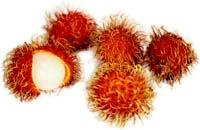
Rambutan cultivation has gradually changed to intensive monocropping. Under the traditional monocropping system, the crop should be able to reach the plateau production, which is about 30 t per ha per year at the age of 13 years with 123 plants per ha.
The recommended planting distance for rambutan is 10 m x 10 m. The planting configuration can either be a square or triangle. Higher density will be obtained in triangular planting. The actual spacing depends on the vigour of the stock-scion combination and on the growing conditions (soil depth, irrigation). If the trees are set too close to each other, they will become overcrowded in a few years and production will be seriously affected. Intercropping is possible in the first few years; later, sole cropping is common. Trees from seed are often found in home gardens and on the borders of fields. Orchards usually consist of clonal trees; they may be pure rambutan stands or mixed plantations with durian (Durio zibethinus) and some langsat (Lansium domesticum) or mangosteen (Garcinia mangostana) trees.
Healthy seedlings are planted in holes of 0.6m x 0.6m x 0.6m. After the holes are dug some organic matter with phosphate fertilizer and limestone are incorporated to mix into the planting holes before introducing the seedlings at the rates of 5 – 10 kg and 0.5 kg respectively. Soil should be compacted around the roots to avoid air pockets.
Mulching is recommended for better moisture retention and weed control. Shade is required to avoid sun scorch in the early phase of growth. |