| |
|
|
|
|
|
|
|
|
 |
| |
|
| |
A packinghouse is a place where the preparation of the produce for market is carried out. It can be built in the farm itself or in other areas that have better infrastructure. A packinghouse can be a simple shed that is similar to in-field collection centres or a complex equipped with all necessary sophisticated facilities.
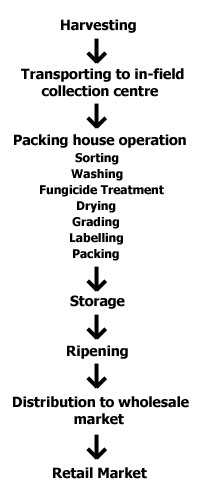
A practical packinghouse should have a good supply of clean water, electricity, an area of washing and drying the fruits, a packing area and storage space. Packinghouse operation can be performed either manually or semi-mechanized. In a packinghouse the fruits undergo a series of operation, which include sorting, washing, fungicide treatment, drying, grading, labelling, packaging and temporary storage before they are distributed to the market ( Figure 1 ).
Figure 1. Flow diagram for handling operation of mango for local market
|
|
On arrival at the packinghouse, the materials that were used to bag the fruits on the tree are removed. Mature-green fruits with a minimum of blemishes and are free from defects and diseases are selected for further operations. |
| |
|
The fruits should be immediately washed with clean water added with 100 ppm sodium hypochloride to remove dust, soil, debris and chemical residue as well as latex stains on the fruit surface. Latex stains are difficult to be removed when dry and can affect fruit appearance. A soft cloth or sponge can be used to clean the fruit but special care should be taken as mangoes are easily bruised by rubbing. |
| |
|
Anthracnose is the most common disease that occurs during the storage and ripening of mangoes. The disease can be controlled by dipping the fruits for 5 minutes in hot water (52°C) containing 500-1000 ppm of benomyl. Fungicide treatment also reduces the incidence of stem end rot, another important storage disease. |
| |
|
Immediately after washing and fungicide treatment, the fruits are air dried to remove excess water from the fruit surface. A blower may be used to accelerate the drying process by blowing warm air on the fruit. |
| |
|
Mango should be graded with extra care according to specified criteria, which include variety , maturity, size uniformity, firmness, cleanliness, and absence of foreign matter, diseases, insect damage and mechanical injury.
The following are grade specifications for mango
Table 1: Grade specification of mango
Grade |
Specification |
Tolerance |
Premium |
Fruit must be from the same variety , fresh and clean. It must be uniform in maturity and size, and also free of disease or injury |
Maturity =5%
Freshness =5%
Injury =5%
Defect =5%
Size uniformity =5% |
1 |
Fruit must be from the same variety , fresh and clean. It must be uniform in maturity and size, and also free of disease or injury |
Maturity =5%
Freshness =5% Injury =5%
Defect =10%
Size uniformity =10% |
2 |
Fruit must be from the same variety , fresh and clean. It must be uniform in maturity and size, and also free of disease or injury |
Maturity =10%
Freshness =10%
Injury =10%
Defect =10%
Size uniformity =10% |
Table 2: Size classification of mango
Size |
Code |
Weight (g) |
|
Maha |
Sala |
Harumanis |
Chokanan |
Large |
L |
|
>500 |
|
>300 |
|
Medium |
|
M |
|
300-500 |
|
200-300 |
Small |
S |
|
<350 |
|
<200 |
|
|
| |
|
High quality individual fruit should be labeled with a sticker of the company's brand. |
| |
|
The purpose of packing is to improve product presentation and to provide protection. Therefore packaging material should be strong, rugged and resistant to pressure. Containers like bamboo baskets and stackable plastic containers are normally used in bulk packing of mango.
Alternatively, telescopic corrugated fibre board cartons are also commonly used. The cartons are perforated to provide ventilation. The carton's smooth walls minimise mechanical injury to fruits.
Fruits are arranged in a single layer inside the cartons. Individual fruit are placed in polystyrene nets or the containers are lined with cushioning material like newsprint, sponge or shredded paper to minimise mechanical injury to the fruits during transportation. Information such as variety , size, weight and country of origin are printed on the outside of the carton. |
| |
|
Sometime fruits have to be temporarily stored before being transported to the markets. Storage at lower temperatures prolongs shelf-life. Mangoes can be kept up to 3 weeks at 12-15°C with a relative humidity of 80-85%. Storage at too low temperature will cause chilling injury to the fruit. |
| |
|
Mangoes are usually ripened before being distributed to retail market outlets. Fully mature fruits normally ripen within 3-6 days under ambient conditions. However, not all the fruits ripened uniformly. Induced ripening of mango is carried out to ensure uniform ripening by exposing the fruit to 5 ppm of ethylene gas at 25ºC for 24 hours. Fruits ripen within 2-3 days after induction. |
| |
|
Some countries require stringent quarantine restrictions on the importation of mango because mango is an important host for the fruit-flies papaya fruit fly and carambola fruit fly .
These countries include the United State of America, Japan, Australia and New Zealand. The fruits, therefore, must be subjected to appropriate quarantine treatments to ensure no fruit-flies survive inside the fruit before being exported to such countries.
Fruits harvested at the correct maturity stage (12 weeks after fruit-set) are exposed to temperatures of 46.5°C and 50% RH for 20 minutes inside a vapour heat chamber. Treated fruit should be immediately cooled with cold water or in an air-conditioned room for about one hour before being packed in corrugated fibre board cartons. |
| |
|
| |
|
| |
| |
| |
|
|
| |
 |
 |
 |
| Names |
| |
|
|
|
Mangifera indica |
|
|
Common: |
|
English: |
Mango |
Indonesia: |
Mangga |
Malaysia: |
Mangga, mempelam |
Tagalog: |
Mangga |
Thai: |
Ma-muang |
Vietnam: |
Xoài |
| Mandarin: |
Mangguo |
| Tamil: |
Maangai |
| Khmer: |
Mak mouang |
| Burmese: |
Thayet |
|
|
Taxonomic Position: |
| |
|
Domain: |
Eukaryota |
Kingdom: |
Viridiplantae |
Phylum: |
Spermatophyta |
| Subphylum: |
Angiospermae |
Class: |
Dicotyledonae |
Order: |
Sapindales |
Family: |
Anacardiaceae |
|
|
|
 |
 |
 |
|
| |
| |
|