| |
|
|
|
|
|
|
|
|
 |
| |
|
| |
Healthy, disease-free planting materials from bona fide cultivars are important for the production of high yield, uniform and good quality pineapples. Where the source of planting material is limited as in the case of newly released cultivars, planting materials are usually propagated using the rapid quartering technique, stem sectioning, leaf bud cutting or tissue culture.Sometimes growth regulators called morphactin containing chloroflurenol are used to induce proliferation of small slips. It induces axillary bud growth after apical dominance has been broken with ethephon application. Planting materials can be increased ten-fold with morphactin induction. For established cultivars, standard planting materials are usually used without resorting to rapid propagation techniques. The conventional planting materials are aerial and ground suckers, large slips and occasionally crowns. |
| |
|
Conventional planting materials
|
|
| |
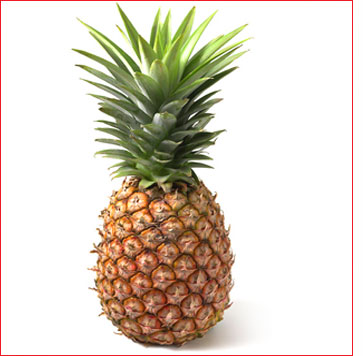
Pineapples are propagated using crowns (tops), slips, and suckers. Crowns are the green leafy tops of the fruit. Slips are small shoots that develop on the upper part of the fruit stalk (peduncle) below the fruit and may have small fruit structures (knobs) at the base. Suckers are the large vigorous shoots that develop from axillary buds on the lower stem and called aerial suckers when they are away from the ground or called ground suckers when emerge beneath the ground. Ground or aerial suckers that emerge close to the ground are very vigorous and are often retained for the ratoon crop.
Planting materials are usually taken from the vigorous ground and aerial suckers. The suckers are usually harvested monthly within a period of 2-5 months after the fruit is picked. Suckers must be uniform in size, with a height of at least 45 cm. The suckers after harvest are left to dry for a few days. The leaves are then trimmed and the suckers dipped in pesticides before planting in the field. The source of planting materials affects the time from planting to fruit maturation. For suckers which are usually the largest propagules, it takes about 14-17 months to maturation while for slips it is 15-20 months. The crowns which are usually the smallest propagules will take 18-24 months from planting to harvesting. |
| |
|
| |
Very rapid multiplication of pineapple plants has been reported to be possible through tissue culture. About 5,000 plantlets from a single crown and 100,000 plantlets from a single shoot can be obtained in 12 months. Dormant lateral buds excised from crown leaves when cultured on Murashige and Skoog basal media containing NAA, IBA and kinetin, produce multiple shoots or plantlets. Plantlets can be rooted in MS salts and vitamins, 0.3 % Phytagel and 1 mg/l napthalene acetic acid (NAA). After four weeks of root initiation, rooted plantlets can be transferred to peat pots and hardened for 8 weeks before planting into the nursery. It will take another 3 months before nursery plantlets can be field-planted. Even though the tissue culture technique is very efficient for rapid multiplication, it has some shortfalls. Mass propagation by this technique produces quite high variability ( somaclonal variation ) among the progenies especially in traits like leaf spine. First-generation tissue culture plants showed less vigour in field performance and bear significantly smaller fruits. |
| |
|
| |
|
| |
| |
| |
|
|
 |
 |
 |
| Names |
| |
|
|
|
Ananas comosus |
|
|
Common: |
|
English: |
Pineapple |
Indonesia: |
Nanas |
Malaysia: |
Nanas |
Tagalog: |
Piña |
Thai: |
Sapparot |
Vietnam: |
Dú'a/ Tho'm Khóm |
| Mandarin: |
Huangli |
| Tamil: |
Annaci palam |
| Laotian: |
Mahk nut |
| Khmer: |
Manoa |
| Burmese: |
Narnuthi |
|
|
Taxonomic Position: |
| |
|
Domain: |
Eukaryota |
Kingdom: |
Viridiplantae |
Phylum: |
Spermatophyta |
| Subphylum: |
Angiospermae |
Class: |
Monocotyledoneae |
Order: |
Commelinales |
Family: |
Bromeliaceae |
|
|
|
 |
 |
 |
|
| |
| |
|