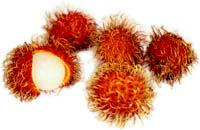
| Rambutans are most commonly eaten out-of-hand after tearing the rind open, or cutting it around the middle and pulling it off. It does not cling to the flesh. The peeled fruits are occasionally stewed as dessert. They are canned in syrup on a limited scale. In Malaysia a preserve is made by first boiling the peeled fruit to separate the flesh from the seeds. After cooling, the testa is discarded and the seeds are boiled alone until soft. They are combined with the flesh and plenty of sugar for about 20 minutes, and 3 cloves may be added before sealing in jars. The seeds are sometimes roasted and eaten in the Philippines, although they are reputedly poisonous when raw. |
Dye uses: young shoots are used as a green dye for silk that has already been dyed yellow with turmeric. The fruit walls are used, together with tannin-rich parts of other plants, to dye silk black after a preliminary red staining. Leaves are used, together with mud, as an impermanent black dye.
Seed fat: the seed kernel can be used for the production of rambutan tallow, a solid fat similar to cacao butter, which is edible and also used for soaps and candles. When heated, it becomes a yellow oil having an agreeable scent. Its fatty acids are: palmitic, 2.0%; stearic, 13.8%; arachidic, 34.7%; oleic, 45.3%; and ericosenoic, 4.2%. Fully saturated glycerides amount to 1.4%. The oil could be used in making soap and candles if it were available in greater quantity. The seed itself is edible (after roasting) but is bitter and narcotic. The wood is suitable for general construction. The tree is very ornamental when it fruits.
Wood: The tree is seldom felled. However, the wood–red, reddish-white, or brownish–is suitable for construction though apt to split unless carefully dried.
Medicinal Uses: The fruit (perhaps unripe) is astringent, stomachic; acts as a vermifuge, febrifuge, and is taken to relieve diarrhea and dysentery. The leaves are poulticed on the temples to alleviate headache. In Malaya the dried fruit rind is sold in drugstores and employed in local medicine. The astringent bark decoction is a remedy for thrush. A decoction of the roots is taken as a febrifuge. |