Growth Habit: The sapodilla is an attractive upright, slow-growing, long-lived evergreen tree. Distinctly pyramidal when young, with age the tree may develops a crown that is dense and rounded or sometimes open and somewhat irregular in shape. It is strong and wind-resistant and rich in a white, gummy latex. In the tropics it can grow to 100 feet, but grafted cultivars are substantially shorter.
Leaves: The leaves are highly ornamental, 3 to 4-1/2 inches (7.62 cm
to
11.43
cm) long and 1 to 1-1/2 inches (2.54 cm to
3.81 cm)
wide. They are medium green, glossy, alternate and spirally clustered at the tip of forked twigs.
Flowers: Sapodilla flowers are small, inconspicuous and bell-like, approximately 3/8 inch (0.95cm) in diameter. They are borne on slender stalks in the axil of the leaves. There are several flushes of flowers throughout the year.
Fruit: The fruit is round to egg-shape, 2 - 4 inches (5.08
cm -
10.16
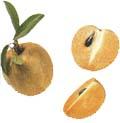
cm) in diameter. The skin is brown and scruffy when ripe. The flesh varies from yellow to shades of brown and sometimes reddish-brown, and may be smooth or of a granular texture. The flavor is sweet and pleasant, ranging from a pear flavor to crunchy brown sugar. Fruits can be seedless, but usually have from 3 to 12 hard, black, shiny, flattened seeds about 3/4 inch (1.91cm) long in the center of the fruit.
Source : http://www.crfg.org/pubs/ff/sapodilla.html
Ecology: The sapodilla grows from sea level to 1,500 ft (457 m) in the Philippines, up to 4,000 ft (1,220 m) in India, to 3,937 ft (1,200 in) in Venezuela, and is common around Quito, Ecuador, at 9,186 ft (2,800 m). It is not strictly tropical, for mature trees can withstand temperatures of 26º to 28º F (-3.33º to -2.2º C) for several hours. Young trees are tenderer and apt to be killed by 30º F (-1.11º C) unless the stem is banked with sand or wrapped with straw and burlap during the cold spell. A number of sapodilia trees have lived for a few years in California without fruiting and then have succumbed to cold. Cool nights are considered a constant limiting factor.
Origins and history: The sapodilla is believed native to Yucatan and possibly other nearby parts of southern Mexico, as well as northern Belize and Northeastern Guatemala. In this region there were once 100,000,000 trees. The species is found in forests throughout Central America where it has apparently been cultivated since ancient times. It was introduced long ago throughout tropical America and the West Indies, the Bahamas, Bermuda, the Florida Keys and the southern part of the Florida mainland. Early in colonial times, it was carried to the Philippines and later was adopted everywhere in the Old World tropics. It reached Ceylon in 1802.
Cultivation is most extensive in coastal India (Maharastra, Gujarat, Andhra Pradesh, Madras and Bengal States), where plantations are estimated to cover 4,942 acres (2,000 ha), while Mexico has 3,733.5 acres (1,511 ha) devoted to the production of fruit (mainly in the states of Campeche and Veracruz) and 8,192 acres (4,000 ha) primarily for extraction of chicle (see under "Other Uses") as well as many dooryard and wild trees. Commercial plantings prosper in Sri Lanka, the Philippines, the interior valleys of Palestine, as well as in various countries of South and Central America, including Venezuela and Guatemala.
Source : http://www.destinationtropicals.com/tropical_plants/plant_52.asp#Propagation |