e-Newsletter - Issue No. 2 | September 2009 |
 |
 |
|
|

by Dr. Roedhy Poerwanto,
Center for Tropical Fruits Studies, Bogor Agricultural University,
Jl. Pajajaran, Bogor, Indonesia
E-mail: roedhy8@yahoo.co.id
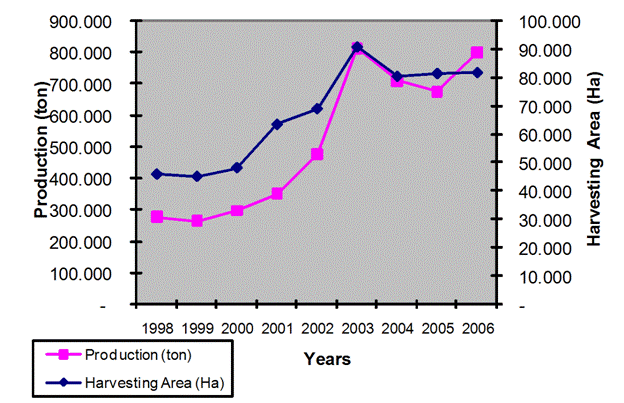
Rambutan is one of Indonesian's native fruit trees. It is categorized as a primary fruit and it accounts for 3.5% of Indonesia's total fruit production (Figure 1). Rambutan produces fruit seasonally as such the fruit is abundantly available.
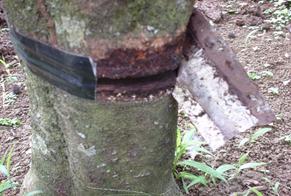
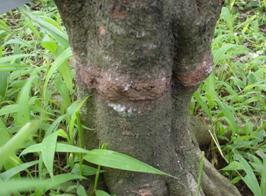
Figure 1. Rambutan production (ton) and harvesting area (hectares) in Indonesia On the contrary, there is hardly any fruit in the markets in Indonesia during off-season. Consequently, it becomes unfavourable for agribusiness in fruits. Therefore, plant manipulation for constant fruit production all the year round is considered very necessary and appropriate. Extending fruiting period, having early fruit season and delaying the end of fruit season can improve this situation. Since not all trees bear fruit at the same time, the period of fruit supply and demand for a longer time can be improved. A critical point in fruiting trees is in the flowering process. So far, the regulation of fruiting in fruit trees in Indonesia still depends on natural processes. From several experiments on tropical fruit trees, it was found that flowering induction need suppression of vegetative growth that occurred when the trees were exposed to drought stress. Drought stress in the dry season is the main factor for floral induction. In almost all tropical fruit trees, the induction of flowering occurs during the dry season and the flowers emerge at the beginning of the rainy season, with fruit harvested 3-6 months later. For example, “Binjani” and “Garuda” varieties require 2 weeks of draught stress while “Rapiah” and “Lebak Bulus” need 1 month of drought stress to flower. Simultaneously, to produce numerous and good flowers, trees need a favorable environment for growth and development of flowers after induction of the flowers in dry season. In spite of that, floral manipulation and induced fruit production have not been commercially practised. Regulating the flowering in fruit trees is economically important in order to get fruits during the off-seasons. Unlike mango, citrus, mangosteen and durian, applications of paclobutrazol did not induce off-season flowering in rambutan. To solve this problem, the technique of ringing the tree was developed to induce off-season rambutan production. Ringing was done by completely removing 2 cm of bark around the trunk and then the wound was immediately is covered with black plastic tape (see Photo 1 & 2). One month after ringing of the trunk, the wound started to recover; callus bridges began to form in between the upper and the lower parts of the ringed bark.
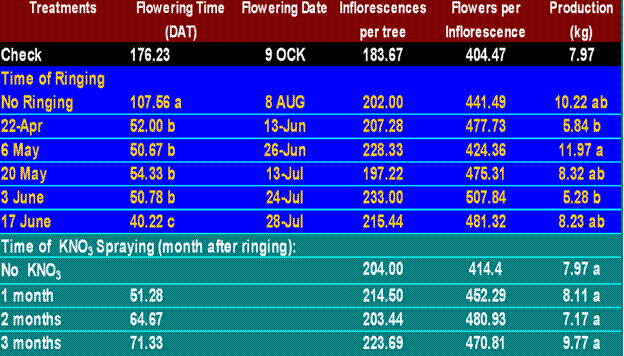
Ringing has been proven to cause “Binjai” rambutan trees to flower and produce off-season fruits. The ringed trees started to produce flowers in the middle of June, while the control trees produced flowers in early October. The flowering time of rambutan trees could be regulated the by timing of ringing. The effect of ringing significantly affected the time of flowering but did not affect the number of inflorescence produced, number of flower per inflorescence, and the size of inflorescence. Foliar application of KNO3 one month after ringing treatment accelerated flowering time 10-20 days compared to those without application of KNO3 (refer to Table1). This bud-breaker compound also increased the inflorescence number per tree. It has been shown that ringing induced flowering of matured rambutan trees off-season even during the off-year.
Table1. Effects of Ringing and KNO3 Spraying on Rambutan Flowering & Fruit Production |
TFNet - Linking People, Technology & Market |
page THREE |