
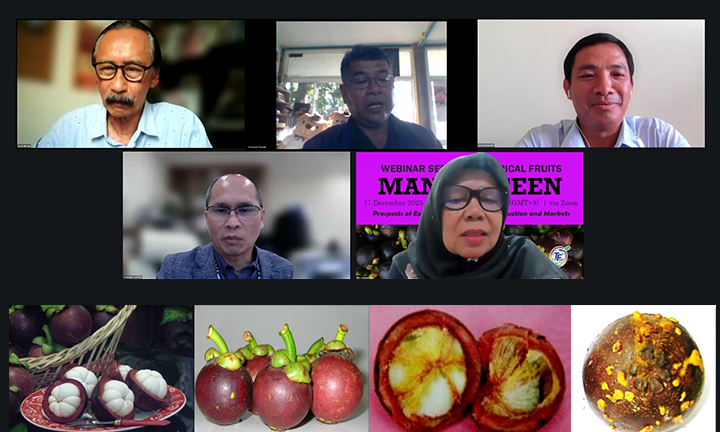
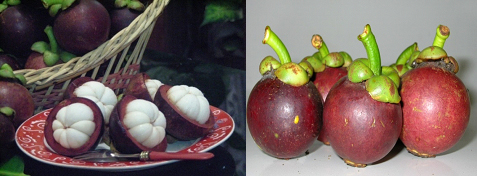
The mangosteen, often referred to as the ‘Queen of Fruits’ for its unique exotic taste and nutritional value, is gaining popularity in global markets. The distinctive purple fruit with its sweet white arils or flesh is protected in a pericarp rich in xanthones, a powerful antioxidant. The hardy, evergreen perennial tree is well adapted to the humid tropics, even tolerating high water tables and flooded conditions.
Indigenous to Southeast Asia, commercial cultivation now spans from SE Asia, South Asia, Latin America and Australia. Leading producers are Thailand, Indonesia, Vietnam, the Philippines and Malaysia, typically grown by mainly smallholders in monoculture, intercropped or mixed cropping and agroforestry systems. Thailand dominates production with an estimated 70,000 hectares, followed by Indonesia (35,000 had), Vietnam (7,600 ha), the Philippines (7,000 ha) and Malaysia (3,500 ha). India currently with approximately 250 hectares is also commercially developing the fruit.
Main producer, Thailand reported a production of approximately 300,000 tons in 2023 and 2024, a portion of which were exported mainly to China, Hong Kong, SEA countries, and smaller amounts to Europa and the US.

Besides the exotic taste, several factors can bolster mangosteens positive market trajectory. Health appeals with antioxidants, vitamins and minerals that align with wellness trends, with ongoing research into xanthones enhances its functional food image. Digital communications and marketing, improved logistics and cold chains, air freight and supermarket proliferation increase global access. Southeast Asia booming tourism introduces the fruit to new consumers, creating demand in nonproducing countries. Furthermore, the premium price for selected, early producing varieties makes cultivation attractive for growers.
While market signals for mangosteens remain relatively stable with a positive outlook, there are uncertainties whether the current situation is sustainable in terms of production and market, or is the trajectory impacted by significant biological and structural challenges that require solutions.
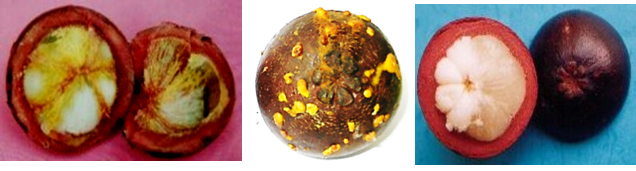
The apomictic nature of mangosteen seeds makes propagation easier, producing mostly true to type seedlings. However, the main challenge is the long juvenile phase where seedlings normally take 5-6 years to bear fruit, due to the root system. This is one factor that has discouraged smallholders from cultivating fruit. Other factors include quality issues that can impact marketability. The fruit is affected by gamboge (latex exudate) on the fruit surface and internally, due to excessive water and mechanical damage during harvesting. Changing weather patten can also cause flesh translucency, another condition that affects quality
Fragmentation of mainly smallholder farmers cultivating the fruit leads to inconsistent production and quality, market access, income volatility and logistical challenges. Besides these, farmer also have other options including growing other more lucrative fruit such as durian or others with shorter juvenile period. Other challenges include pests and diseases, fruit perishability and shelf life.
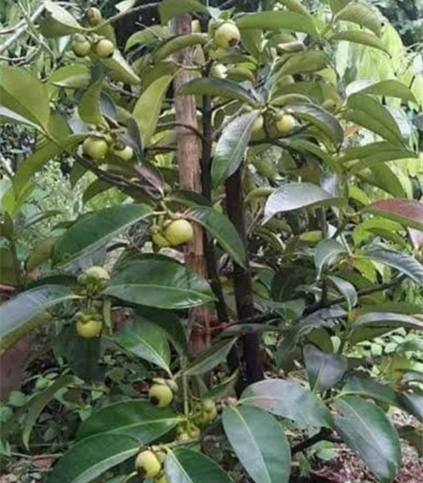
The past decade has seen improvements in mangosteen production due to research and improved practices. For instance, top grafting seedlings with scion from selected plants reduces the unproductive phase from over 5 years to 3 years, a technique adopted in Thailand, Vietnam, Indonesia and Malaysia. Improved field practices including balanced fertilizer application, pest and disease control and better harvesting techniques have generally yielded better fruit quality. Scanning machines have been used especially in Thailand to sort out fruits that have internal disorders for the export market.
In the area of value addition, except for leveraging on the xanthones rich pericarp, there has not been substantial thrust in other value addition products although there have been initiatives into freeze-dried products.
A key question is whether mangosteen can still remain on a sustainable path. Currently, while the situation in major producing countries appears status quo with slow growth, the way forward to improve cultivation of mangosteens will include more research and development into early-fruiting techniques and cultivars, improvement in root architecture to promote faster growth, pests and disease management, minimizing of gamboge incidences and yield consistency. The use of gamma radiation has been reported to improve shelf life of the fruit.
Since mangosteen is largely cultivated by smallholders, the value chain is has to be strengthened with a strong network among growers, wholesalers, traders and retailers, to improve market access and supplies through contract agreements, at the same time manage quality, reduce postharvest losses and improve logistics. Another area that can be expanded is promoting cultivation systems that align with environmental sustainability such as agroforestry.
One specific area that needs to be cleared up is the misrepresented data in production areas due to the harmonized system in which mango, guava and mangosteen have been included in one group, FAO will list mangosteen as a separate commodity under a new harmonized system in 2028, improving date clarity.
The challenges and opportunities in improving mangosteen production and markets were discussed in a webinar organized by International tropical fruits network (TFNet) on 17 December 2025. Experts from India, Indonesia, Malaysia, Thailand and Vietnam presented country perspectives. The webinar was attended by 131 participants from 13 countries including Malaysia, Thailand, India, Vietnam, Philippines, Fiji and Australia, indicating global interest in the future of the ‘Queen of Fruits.’