
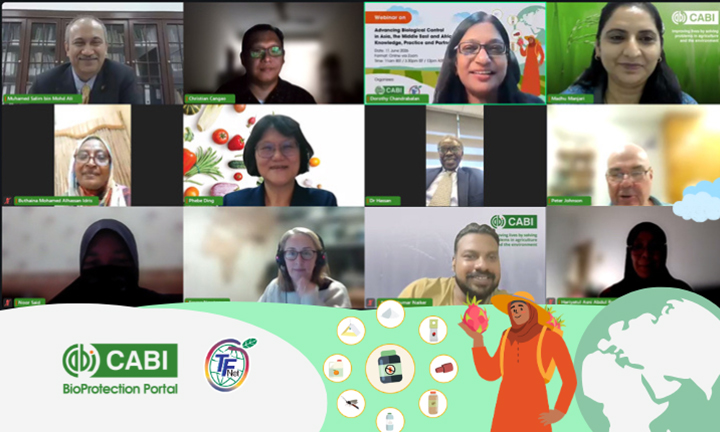
The regional webinar, “Advancing Biological Control in Asia, the Middle East and Africa: Knowledge, Practice and Partnership,” was jointly organized by CABI and the International Tropical Fruits Network (TFNet) on 11 June 2026. The webinar recorded an estimated peak attendance of about 376 participants, representing six regions: Asia, the Middle East, Africa, Europe, the Americas and the Pacific. The level of participation reflected growing recognition of biological control as an important component of Integrated Pest Management and sustainable agriculture.
In her welcome remarks on behalf of TFNet, Dr. Dorothy Chandrabalan, Technical Officer and moderator of the webinar, highlighted TFNet’s role as an international network that promotes the sustainable development of the tropical fruit sector through knowledge sharing, capacity building, technical cooperation and partnerships. She noted that the webinar aimed to strengthen awareness and understanding of biological control as a practical component of sustainable pest and disease management, while providing a platform to share technical knowledge, digital tools, country experiences and opportunities for regional collaboration.
Setting the context for the webinar, Dr. Malvika Chaudhary CABI’s Plantwise Plus Global Team Leader – Digital Product Usage, underscored biological control as an increasingly important approach to reducing dependence on chemical pesticides, particularly as farmers face rising concerns over pesticide resistance, residue limits, market rejection, environmental safety and consumer health. She explained that biological control, whether through conservation, augmentative or classical approaches, must be supported by enabling policies, suitable regulatory pathways, quality assurance, farmer-centred training and stronger last-mile access to information and inputs. Drawing on CABI’s experience, including digital extension efforts in India, she noted that the wider uptake of bioprotection products depends not only on technology, but also on multi-stakeholder collaboration involving researchers, regulators, extension systems, input suppliers, producers and farmers.
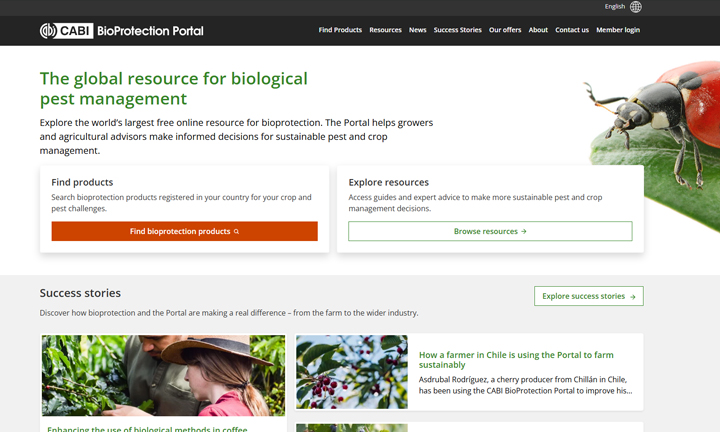
A key feature of the webinar was the presentation and live demonstration of the CABI BioProtection Portal by Mrs. Madhu Manjari, Agri-Digital Tools Coordinator for South Asia, CABI. The portal, an open-access online platform supports users in identifying registered bioprotection products based on country, crop and pest. The presentation highlighted the portal’s role in providing practical information on biocontrol agents, product categories, application guidance, and related pest and crop resources. It was noted that the platform was available in 18 languages and is intended to support a range of stakeholders, including growers, advisors, national authorities and biocontrol manufacturers. Mrs. Madhu also demonstrated the main features of the portal, showing how users can navigate the platform and apply the information to support informed decision-making and the wider adoption of bioprotection solutions.
The webinar also featured a practical case study by Dr. Sivapragasam Annamalai, CABI Associate and former Regional Director of CABI Asia. Dr. Siva shared experiences on the use of biological control within Integrated Pest Management approaches, drawing on pioneering research conducted with Malaysian agricultural researchers on the diamondback moth (Plutella xylostella) in the Cameron Highlands. The case study highlighted how the pest had become a major threat to cruciferous crops, particularly cabbage, due to widespread insecticide resistance and heavy pesticide dependency. To address this challenge, an Integrated Pest Management programme was developed, with emphasis on biological control using natural enemies, including parasitoid wasps to suppress pest populations. The programme also promoted the use of economic threshold levels to guide pesticide application decisions more judiciously. The presentation underscored the importance of sustainable, evidence-based pest management approaches that can reduce reliance on broad-spectrum chemical pesticides, address residue and consumer concerns, and deliver clear economic benefits to farmers.
Country and institutional perspectives were shared by speakers from Egypt, Sudan and Saudi Arabia. Dr. Hesham Sayed Tawfik Ghazzawy from Agricultural Research Center, Egypt highlighted institutional efforts in biological control, sustainable agriculture, research, extension services, farmer field schools and the application of modern technologies. Mrs. Buthaina Mohamed Alhassan Idris from the Federal Ministry of Agriculture and Irrigation, Sudan shared practical experiences in horticultural production, including examples such as the use of neem oil and microbial biopesticides within smallholder farms and natural production systems. Professor Hassan Ali-Dinar from King Faisal University, Saudi Arabia provided an overview of efforts to promote biological control within broader national Integrated Pest Management strategies, highlighting the importance of farmer awareness, government support, organic agriculture programmes, private sector involvement and extension systems.
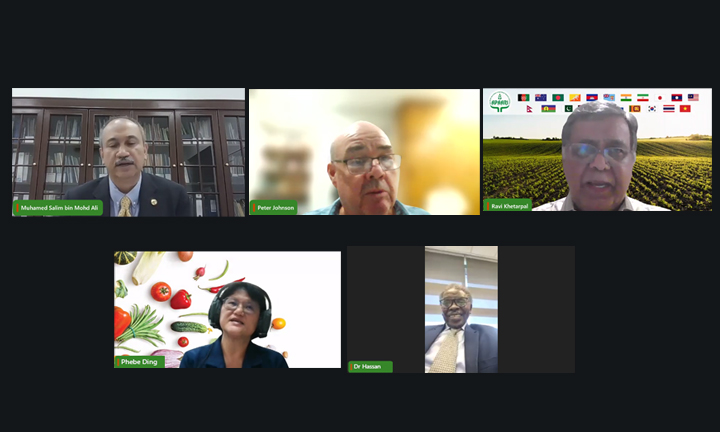
The panel discussion was moderated by Mr. Muhamed Salim bin Mohd Ali, Chief Executive Officer of TFNet. Panellists included Prof. Hassan Ali-Dinar of King Faisal University, Mr. Peter Johnson, TFNet Board Expert from Australia, Prof. Phebe Ding of Universiti Putra Malaysia and TFNet Board Expert, and Dr. Ravi Khetarpal of Asia-Pacific Association of Agricultural Research Institution (APAARI). The discussion focused on how biological control can be translated from research and project-based interventions into practical, scalable and sustainable solutions for farmers, industry stakeholders and national agricultural systems. Key issues discussed included long-term project design and measurable impact, scaling across different country contexts, farmer-friendly and affordable solutions, the role of exporters, buyers and producer groups in encouraging adoption, the influence of biological control on fruit quality, shelf life and postharvest losses, and the importance of partnerships, capacity development and regional cooperation in supporting sustainable biocontrol systems.
Several key messages emerged from the webinar. Biological control was recognized not as a direct replacement for chemical pesticides, but as an important and practical component of sustainable pest management. Speakers emphasized that it contributes to safer, more resilient and sustainable production systems through Integrated Pest Management, improved access to reliable bioprotection products and stronger support for farmers.
A major takeaway was that successful biological control requires more than technology alone. It needs strong collaboration among researchers, governments, extension services, the private sector, development partners and farmers. Adoption at farm level also depends on practicality and clear value, with farmers requiring solutions that are affordable, accessible, easy to use and supported by field evidence, including demonstrated economic benefits.
The discussions also highlighted that biological control could help address key concerns such as pest resistance, pesticide residues, market compliance, environmental safety and consumer confidence. Tools such as the CABI BioProtection Portal were recognized as important resources for supporting better decision-making by providing reliable, up-to-date information on registered bioprotection products.
Moving forward, the webinar reinforced the importance of regional knowledge exchange. While biological control interventions are often implemented locally, many lessons, approaches and partnerships can be adapted and shared across countries and regions. Priority areas identified include strengthening capacity, improving access to suitable biological control products, supporting farmer adoption and building partnerships that can translate knowledge into practical action on the ground.
The recording of the webinar can be found in CABI’s YouTube channel.