
SOURCE: Phys.org
A new study suggests that with low to moderate levels of global greenhouse emissions in coming decades, more of India could become suitable for growing avocadoes. However, with high enough emissions, growing zones could shrink and destabilize by 2070.
Researcher G. Karunakaran of the Indian Council of Agricultural Research’s Indian Institute of Horticultural Research and colleagues present these findings in PLOS One.
Rising global demand for avocadoes makes them an economically significant fruit crop. Indigenous to Central and South America, commercial cultivation now occurs in additional regions, including parts of India.
However, with a shifting global climate, the future of avocado-growing in India has been unclear. To assess the possibilities, Karunakaran and colleagues used an approach known as ensemble species distribution modeling, in which they combined eight different machine-learning algorithms to evaluate which parts of India may become more or less suitable for avocado-growing by 2050 and 2070, considering future conditions of low, moderate, or high global emissions.
The analysis incorporated key factors affecting avocado suitability, such as forest cover, urbanization, and the lowest temperature reached in the coldest month.
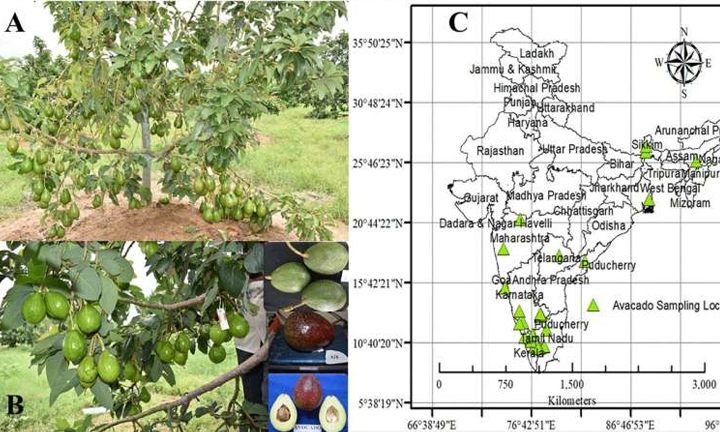
The analysis suggests that currently, India’s most suitable avocado-growing areas are in the southern states of Kerala and Tamil Nadu—indeed, most avocadoes grown in India already come from these areas.
Under low to moderate future emissions scenarios, the analysis predicts that suitable growing zones will modestly expand northward and to higher elevations, including into the Western Ghats mountain range, eastern India, and the northeastern hills—provided that temperature and precipitation patterns in these areas remain within avocado-friendly thresholds.
However, if global emissions continue to increase as they already have been (a “business-as-usual” scenario), suitable avocado-growing areas could become redistributed into transient, fragmented, high-elevation patches that may degrade or disappear by 2070, the analysis suggests.
On the basis of these findings, the researchers call for the identified potential expansion zones to be prioritized for conservation, and for policies to promote climate-resilient avocado cultivation strategies.
The authors add, “Using ensemble species distribution modeling, our study shows that avocado cultivation in India could expand into new regions under low to moderate emission scenarios, but high-emission pathways may fragment and destabilize suitable growing zones. These findings highlight the importance of climate-smart planning to safeguard future avocado production.”