
SOURCE: BSS News
By cultivating improved varieties of guava, farmers of Khulna region become very happy as its bumper production changes their fortune and makes them self-reliant.
According to the Department of the Agricultural Extension (DAE) of Khulna Region, farmers have cultivated 1,531 hectares of land with a production target of 21,811 tonnes of guava.
Of the Agro-region, a total of 423 hectares of lands were cultivated with a production target of 5,543 tonnes of guava in Khulna while 524 hectares of land were cultivated with a production target of 7,195 tonnes of guava in Bagerhat, 410 hectares were cultivated with a production target of 7,443 tonnes in Satkhira and 174 hectares were cultivated against 1,630 tonnes of guava in Narail district.
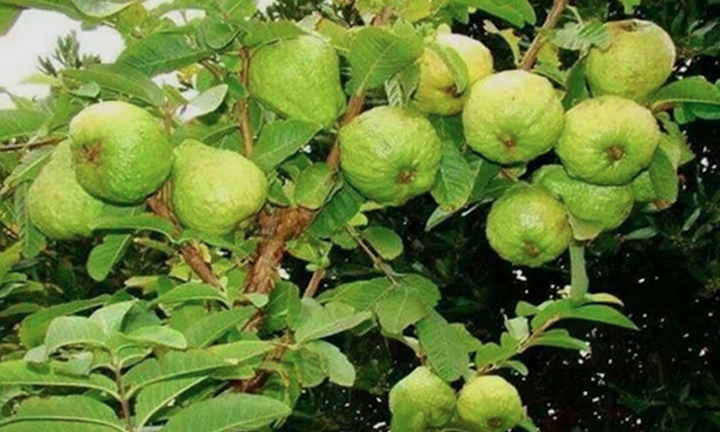
During a visit in Golna village under Dumuria upazila in Khulna on Friday, the reporter witnessed beautiful scenery where numerous guava are hanging on the tree at many orchards.
Talking to BSS, Monirul Islam, 38, a guava farmer, said that he initially started growing a new variety of guava, called Thai guava, on six bighas of leased land about two years ago in hopes of turning his fortunes.
And while he was initially skeptical about the crop’s potential, his doubts have since been blown away as Thai guava has become a favourite among the people of Bangladesh.
“I was not aware about the prospect of Thai guava as I was doubtful about the yield and profit, but my doubts eventually turned into hope after getting results,” Islam said.
Having attained financial freedom, Islam now looks to expand his guava orchard.
After meeting all the expenses, his current orchard rakes in a profit of about Taka 3.5 lakh to Taka 4 lakh per year.
Another farmer Emon Khan, 42, of the same village, has achieved remarkable success through commercial guava farming. By cultivating improved varieties of guava, he has become financially self-reliant and an example for others in the region.
Talking to BSS, he said he invested Taka 4 lakh in his guava orchard and expects to earn around Taka 12 lakh to Taka 13 lakh from sales this season.
“The improved variety of guava bears fruit throughout the year with minimal cost,” he added.
“Each guava weighs between half a kilogram to one kilogram, and a tree can produce fruit continuously for six to seven years,” Emon added.
Currently, he has 1,200 guava trees planted on seven bighas of land, selling the fruit at Taka 130-150 per kilogram.
After enjoying early success, he invested Taka 12 lakh to expand his farm last year and got good yields and profits.
Inspired by his success, many local farmers have also started guava cultivation. Farmers like Shariful Islam of Panchur village under Gutudia Union and Debprasad Biswas of Shalua village have been tending guava orchards for several years.
Across Dumuria, fields are now filled with improved guava varieties, and many young entrepreneurs and unemployed youths are turning to guava farming for profit.
According to Upazila Agriculture Officer Md Insad Ibne Amin, guava has been cultivated on 30 hectares of land this year.
“Compared to traditional crops, guava farming yields three times more profit,” he said.
“Saplings from Khulna Horticulture Center are planted at the end of the Bangla month of Baishakh, and the trees start bearing fruit within nine months,” he added.
Each tree produces 100-150 fruits, but farmers are advised to keep only 20-25 fruits during the early stage to ensure tree health.
Although guavas grow year-round, the spring season fetches the highest prices. To prevent insect infestation and fruit rot during the monsoon, farmers apply balanced fertilizers and cover the fruits with polyethylene wrappers.
The improved guava trees remain productive for at least seven years, producing sweet and high-quality fruit. Many local farmers are now shifting from traditional crops to guava cultivation due to its profitability.
Md Rafiqul Islam, additional director of the Department of Agricultural Extension (DAE) in Khulna, said, “Guava is a highly profitable crop. On one bigha of land, farmers can plant around 425 trees, each producing up to 20 kilograms of fruit annually. At current wholesale rates of Taka 1,500 per maund, a single tree can generate around Taka 4,000 in revenue per year.”
He said farmers cultivated mainly Thai and Egypt guava with many varieties including popular Sayde guava locally known as ‘Kanchan’, Thai-3, Thai-5, Thai-7, Thai Golden-8 and Egypt variety guava side by side with local variety.
The DAE officials regularly visit guava orchards to provide training on eco-friendly pest control and modern cultivation methods, he added.
Farmers in the region are also being encouraged to grow intercrops like lemon, strawberry, watermelon and malta within their orchards for diversified income and sustainable farming.