e-Newsletter - Issue No. 1 | July 2009 |
 |
 |
|
|
|

by Dr. Vo Mai Phong, MSc. Extension Section, Department of Agriculture, Ho Chi Minh City, Vietnam
(Edited by Dr. Osman Hashim of TFNet)
Vietnam with a total fruit production area of 776,500 ha (2007) is planning to increase it to 1,000,000 ha by 2010 in the following regions namely, North east, North West, Red River Delta, Central North, Central Highland, Central South, South East and Mekong Delta for planting of various types of tropical fruits including the dragon fruit - a quantitative (facultative) long day plant. The cultivation of dragon fruit in Vietnam began several decades ago when dragon fruit cuttings were brought from Binh Thuan province and grown in two provinces ‘Long An’ and ‘Tien Giang’ in the Mekong Delta. Now dragon fruit production has expanded to more locations of the country even in the North. The total dragon fruit area in Vietnam (mainly from 3 provinces: Binh Thuan, Long An, Tien Giang) is about 10,000 ha with the average total yield of about 150,000 tones. Presently, red dragon fruit (Hylocereus polyrhizus) with red flesh and pink peel (introduced by Fruit Research Institute of the South - SOFRI) is also grown in small scale in South of Vietnam.
Planting material: Two to three years old strong and dark green branches are selected from healthy trees. They are cut into pieces of 40 - 50 cm long cuttings with good eyes covered by strong thorns and without injuries or pest infestations. The cuttings should be treated with pesticides to control pests and diseases, thirty days before planting.
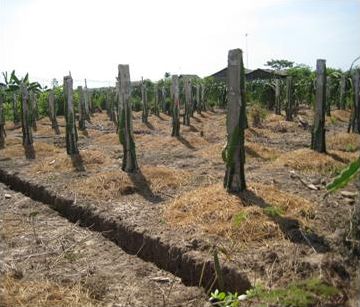
Planting: Dragon fruit cuttings are planted 3m x 3m or 3 m x 2.8 m apart (planting density 1,100 - 1,300 per ha) on beds 40 - 50 cm high and 3 m broad of loose soil with supporting posts (concrete posts - 12 cm diameter planted into the soil with 1.4 m-1.5 m of it above ground or live trees which compete for nutrients and transfer pest and diseases to the plants). They are best planted at the end of the rainy season which is suitable for the development of the cuttings to young trees. Mounds should be prepared from loose soil mixed with fertilizer (20 kg organic fertilizer + 0.5 kg super phosphate + 1kg NPK (16-16-8) per 50 supporting posts planted in the center before planting. Three to four cuttings are planted around each supporting post, securely tied and covered with soil and straw. Since dragon fruit trees prefer sunshine, the distance between trees must be kept at optimum so that the trees can receive enough sunshine for their development. (see photos below)
 |
 |
|
Fertilization: During the first year, 50 g Urea + 50 g Super Phosphate/ 3 times/ year/ supporting post. At fruit bearing stage, 0.5 kg Urea, 0.5 kg Super Phosphate, 0.5 kg Potassium and 20 kg Organic fertilizer/ 3 times/ year/ are applied around each supporting post. Additional application of micro elements such as foliar fertilizer is applied 1 time/ week when the fruits are developing. Fertilizer application should stop at least 10 days before the fruits are harvested.
Irrigation: Although dragon fruit trees can withstand drought well, irrigation is necessary depending on wetness of the soil in dry season and also during the lighting period for “out- of season” dragon fruit. Irrigation is done at intervals of 3 or 7 days. A ditch is constructed between trees to contain the irrigated water and rain water for the purpose of keeping the dry soil moist.
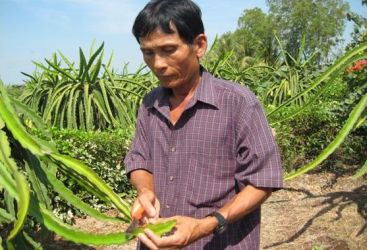
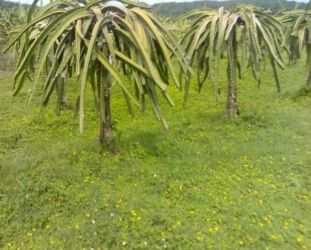
Pruning: Light pruning is carried out during the second year after planting followed by main pruning when the trees are three years old. Non-productive and small branches are removed from the trees to create an umbrella form. (see Picture 1 & 2)
Weeding and covering of the tree base: Noxious weeds are removed before any fertilizer application. Non-competitive weeds are left to cover the bed to limit water evaporation and vaporization of fertilizer. Finally, the bases of supporting post are covered with 10 kg of coconut peat as organic fertilizer and to aerate the soil.
 |
 |
|
Picture 1 |
Picture 2 |
|
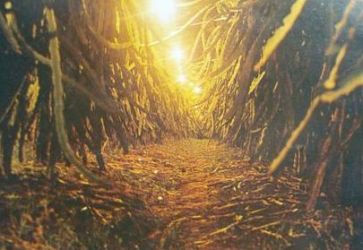
Flowering stimulation: The treatment is done by lighting the plants using 75 - 100 w light bulbs for 5 - 6 hours per night for 15 - 20 nights in July and August; 20 - 25 nights in December and January of the following year during appropriate weather condition and health of the dragon fruit trees. Properly synchronized and orderly switching on and off of the lighting must be maintained in order to get effective lighting during floral stimulation. The lighting system must be hanged on posts above the worker’s head and should be removed completely when lighting is no longer required. Available stimulant substances should be used twice at flowering stage, the first time is 3 days before flowering and the second time is 7 days after budding. (see Picture 3)
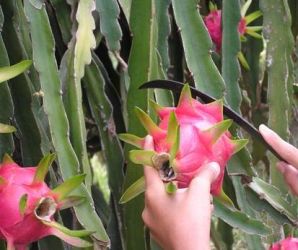
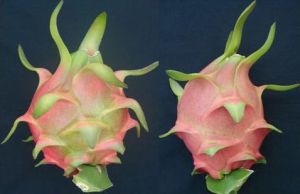
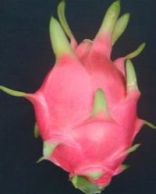
Harvest: Fruit harvest commences after the fruits change color from green color to red. Usually gardening knife or scissor is used to cut the fruits from the branches. The harvested fruits are put into bamboo baskets and carried to sorting sheds. (see Picture 4)
 |
 |
 |
|||
Picture 3 |
Picture 4 |
Right color for harvest |
 |
||
Too ripe for harvest |
||
Grading: The grading of the fruit should be done right in the orchard, in the packing house or in the wholesale markets. The graded fruits were put into bamboo or plastic baskets, weighted and transported to the packing house where they are cleaned, followed by chlorine wash, air-dried and then packed according to the buyer’s demand (see Picture 5). Loss after harvest is about 30%.
Postharvest Treatments and Handling: Dragon fruits can be easily damaged by fungus or bacteria. Thus, they are washed with chlorine solution (2,000 ppm) to control the micro-organisms. Exposure to ozone can also reduce fruit damage.
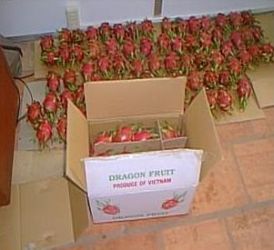
Packaging: The fruits are packed in cartons so that the ears of the fruit cannot be damaged. (see Picture 6)
Storage: Controlled atmosphere storage or use of MAB (modified atmosphere bag) can extend the shelf live of the fruits for about 42 days. Fruits kept in polyethylene bags perforated with small holes of 0.5mm diameter stored in cool condition (50 °C) with humidity of 90 - 95% can also last for 42 days.
| Picture 5 |  |
 |
Picture 6 | |||
(For more details on this article please go to our website http://www.itfnet.org, look for "Other news & events - Pitaya Seminar Downloads")
TFNet - Linking People, Technology & Market |
page FOUR |