
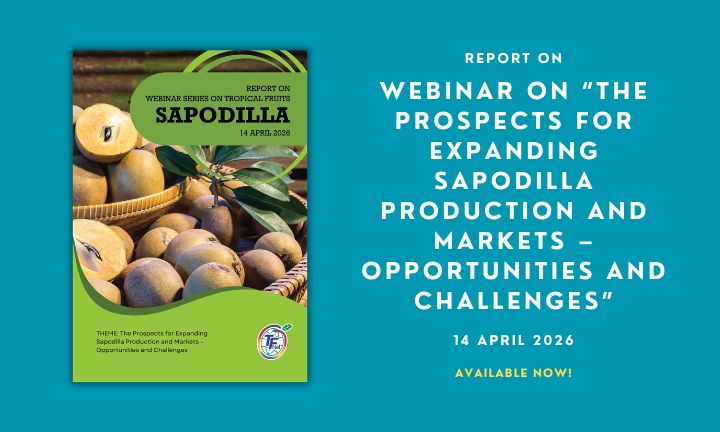
Download the full report here.
Sapote, also widely known as sapodilla, chiku, safeda or sawo, is a familiar fruit in many tropical countries. Known for its sweet, soft flesh and distinctive caramel-like taste, the fruit has long been consumed in domestic markets, home gardens and traditional farming systems. Yet, despite its consumer appeal and adaptability, sapote remains largely underdeveloped as a commercial tropical fruit crop in many producing countries.
Across Asia, however, renewed interest is emerging in the future of sapote. While it may not yet command the same commercial attention as mango, durian, avocado or dragon fruit, the fruit has several attributes that could could strengthen its commercial potential in the years ahead. It is already known to consumers in many producing countries, can be grown under a range of tropical conditions, and offers potential for both fresh consumption and value-added products.
India remains one of the major producers of sapote with 40-50 varieties grown all over the country. Established production areas include Andhra Pradesh, Gujarat, Maharashtra and other states. In Gujarat and Maharashtra, the crop has the advantage of flowering and fruiting throughout the year, allowing more continuous market supply. India also has GI-recognized sapote varieties, such as Gholvad and Amalsad Chikoo, which can strengthen branding and support premium market positioning.
In Indonesia, sapote, locally known as sawo, is widely distributed but remains mainly a home garden and mixed-farming crop. The country has a large domestic market and considerable genetic diversity in sapote, with variations in fruit size, shape, taste and quality. This diversity offers opportunities for selecting superior types, although it also creates challenges in achieving uniform fruit quality for modern markets.
Bangladesh presents a different picture. Sapote is considered an off-season fruit, usually available during the winter period when many other local fruits are less abundant. The crop is grown mainly in the southern belt of the country and is valued for its sweetness and nutritional contribution. Although demand is reported to be increasing, production has remained relatively stable, constrained mainly by weak market systems and high perishability.
In Viet Nam, sapote is cultivated in selected areas, including the Mekong Delta and Red River Delta, where varieties such as Mac Bac and Mexico have gained attention. The Mexico variety, with its larger fruit size and attractive appearance, has potential for supermarket and urban markets. Viet Nam’s experience also points to opportunities for certified production areas, improved pest management and better branding to strengthen market access.
The regional outlook for sapote is therefore cautiously positive. Demand exists, and in some countries, it is growing. The fruit is familiar, sweet, nutritious and suitable for urban, traditional and niche markets. However, its future development will depend on whether the sector can address several persistent constraints.
The most serious challenge is post-harvest loss. Sapote is highly perishable, with soft flesh and thin skin that make it easily bruised during harvesting, handling, transport and marketing. Its short shelf-life limits long-distance distribution and makes export development difficult. In some countries, post-harvest losses remain high because of inadequate packaging, limited cold chain facilities, weak grading systems and poor handling practices.
Unlike fruits with firmer skin and longer storage life, sapote requires careful handling at almost every stage of the value chain. Fruits may be damaged when harvested manually, transported in unsuitable containers or pressed by traders and consumers to check ripeness. These small injuries can accelerate softening and reduce market value. For this reason, post-harvest management is one of the most important areas for future research and investment.
Several technical options are already being explored. In India, work on latex removal, pre-cooling, storage temperature and improved grading has shown potential for maintaining fruit quality. Cooperative societies in South Gujarat have introduced automated grading and sorting systems, helping to improve market presentation. In Viet Nam, improved packaging, fruit bagging and integrated pest management models are being promoted to reduce losses and improve fruit safety. Bangladesh has identified packaging, storage, transport and processing as priorities, while Indonesia has highlighted the need for soft-handling technologies and shelf-life extension.
Another important issue is planting material. In several countries, sapote is still propagated from seed or grown from old, scattered trees, resulting in inconsistent fruit quality. This is particularly evident in Indonesia, where high genetic diversity is both an opportunity and a constraint. Greater use of clonal propagation, grafting and elite genotype selection could help produce more uniform fruits and support commercial orchard development.
India’s sapote industry is dominated by the Kalipatti variety, which is valued for its taste and quality. However, dependence on a narrow varietal base may create risks if pest or disease pressures increase. Bangladesh has released improved varieties such as BARI Safeda-1, BARI Safeda-2 and BARI Safeda-3, while Viet Nam has developed interest in varieties such as Xuan Dinh, Thanh Ha, Mac Bac and Mexico. Across the region, varietal development and quality planting material remain essential for improving productivity and market reliability.
Sapote’s production systems also reflect its status as a minor tropical fruit. In Indonesia, it is still largely a backyard crop. In Bangladesh, it is grown in scattered production areas and increasingly in urban roof gardens. In India, many older orchards have large canopies and wide spacing, making harvesting and management difficult. In Viet Nam, commercial development is more focused in selected production zones. These differences suggest that the future of sapote will not depend on one production model, but on adapting technologies to local systems, whether smallholder orchards, mixed farms, urban gardens or more organized commercial plantings.
Pests and diseases are another area requiring attention. Fruit fly, fruit borer, mealybugs, stem borer, leaf miner, bud borer and seed borer were among the problems highlighted by experts. While sapote may not face the same level of pest pressure as some major tropical fruits, pest damage can reduce fruit quality and affect marketability. Integrated pest management, orchard sanitation, fruit bagging, balanced fertilization and selective use of control measures will become increasingly important as markets demand safer and better-quality fruit.
Value addition may provide one of the strongest pathways for sapote development. Since fresh fruit marketing is limited by perishability, processing can help reduce losses and extend market reach. Sapote can be processed into jams, jellies, fruit bars, dehydrated slices, powders, juices, milkshakes, desserts, syrups, fermented beverages and probiotic drinks. In India, processed sapote powder has potential for use in smoothies, desserts and health products. In Indonesia, small-scale research and product development have explored puddings, chips, syrups and functional products. Bangladesh has also identified ready-to-serve drinks, fruit bars, jams and jellies as areas for future development.
However, processing is still limited in most countries. Much of the work remains at household, laboratory or small-enterprise level. To become commercially viable, value addition will require investment from private companies, stronger links between farmers and processors, consistent raw material supply, food safety compliance, product development and market testing.
Branding is another area where sapote could gain ground. At present, the fruit is often perceived as a traditional or low-value fruit. This limits consumer interest beyond existing markets. Experts suggested that sapote could be repositioned as a nutritious, functional and consumer-friendly tropical fruit. Its sweetness, soft texture and low acidity make it attractive to many consumers, while its familiarity among diaspora communities could support niche export markets.
India’s geographical indication initiatives show one possible direction for strengthening identity and market differentiation. Viet Nam’s interest in certified production areas and supermarket supply also points to a more quality-focused future. Indonesia’s proposal to rebrand sapote from a traditional fruit into a functional fruit highlights the need to change consumer perception. Bangladesh, meanwhile, may benefit from stronger domestic promotion, market organization and processing-based entrepreneurship.
Despite the positive signals, the sapote industry is unlikely to expand sustainably through area expansion alone. The more strategic direction is to focus on value rather than volume. This means improving fruit quality, reducing losses, extending shelf life, developing processed products, strengthening farmer organization and building stronger market identity.
These issues were discussed during a webinar organized by the International Tropical Fruits Network on “The Prospects for Expanding Sapodilla Production and Markets – Opportunities and Challenges” on 14 April 2026. The session brought together Dr. Yatin Tandel from Navsari Agricultural University, India; Prof. Dr. Darda Efendi from IPB University, Indonesia; Dr. Most. Marufa Khatun from the Bangladesh Agricultural Research Institute; and Dr. Nguyen Thi Kim Thoa from the Southern Horticultural Research Institute, Viet Nam. The discussion was moderated by Mr. Yacob Ahmad of TFNet.
The experts agreed that sapote has room for improvement in both production and demand, but that the crop requires more targeted development. India has a strong production base but needs better post-harvest systems, value addition and export-oriented supply chains. Indonesia has genetic diversity and a large domestic market but needs clonal propagation, uniformity and branding. Bangladesh has growing demand but requires improved market systems, storage and processing. Viet Nam has opportunities in improved varieties, certification and supermarket supply, but must continue to address pests, post-harvest losses and branding.
The direction for sapote is clear. The fruit has potential, but its future will depend on how well countries address the technical and market bottlenecks that have kept it in the background. With better planting materials, improved post-harvest technologies, integrated pest management, value addition and stronger branding, sapote could move from a traditional backyard fruit into a more visible and commercially viable tropical fruit in regional markets.