
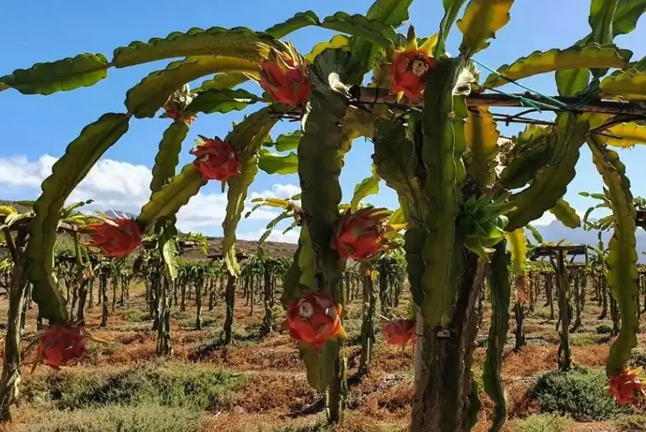
SOURCE: Lisakanya Venna, Food for Mzanzi
Driven by growing health consciousness, rising demand for organic produce, and expanding global trade chains, the global dragon fruit market is experiencing rapid expansion. In South Africa, however, local producers and plant material suppliers face a contrasting reality.
According to a recent report by MarkNtel Advisors, the global market size was valued at approximately USD 678 million in 2024 and is projected to reach USD 995 million by 2030, growing at a compound annual growth rate (CAGR) of around 7.99%.
However, while neighbouring countries expand production and global consumption soars, South African farmers are grappling with capital constraints, unpredictable weather conditions, poor local consumer perception, and strict environmental regulations.
Capital barriers and climatic realities
In neighbouring regions, the crop has shown strong performance under hot, dry conditions. According to Cornelius Andrias van Heerden from Wonderful Dragon Fruit, dragon fruit thrives in dry, warm weather and performs well during El Niño cycles.
“The weather is getting better; it loves dry, warm weather, one of the crops that do good in El Niño. It does so well in Zim, Botswana, and Zambia. I am so proud of the farmers that are farming there.
“There are so many SA farmers that want to farm, but the funding for starting is at a complete halt. They have the land, motivation, and skills, just for them to get started,” Van der Heerden said.
While dragon fruit is a cactus species and relatively drought-tolerant, its commercial performance in South Africa’s subtropical regions has proven more sensitive to weather patterns than early industry projections suggested.
Lauren Strever, managing director of Amorentia Estate and Nursery, explained that while the crop was initially promoted as a promising alternative crop for subtropical zones, climatic nuances play a heavy role in farm yields.
“I think some of the expectations were probably too optimistic, particularly around climatic suitability. Dragon fruit was promoted as a crop that would perform well in South Africa’s subtropical areas. What we have found in practice is that the crop can be much more sensitive to climatic conditions than initially expected.
Strever noted that excessive summer rainfall and prolonged wet conditions significantly impact production. “A very wet summer can be detrimental to production. Dragon fruit may be relatively drought tolerant, but that does not mean it performs well under prolonged wet conditions.
“Excessive rainfall and humidity can affect flowering, fruit development, and overall production. Being located in a subtropical climate does not automatically mean that conditions are ideal for dragon fruit.”
Overcoming market perceptions and regulatory barriers
Beyond weather and initial capital investment, South African growers face consumer resistance linked to fruit quality on local retail shelves.
“The market challenge is more around what constitutes a good-quality dragon fruit. Older, bland-tasting fruit still dominates the South African market.
“Although growers are increasingly planting red, pink, and white selections that are sweeter and have significantly better eating quality, this newer production has not yet replaced the older white, bland-tasting fruit on local shelves,” Strever said.
She pointed out that while high-quality selections are exported, top-tier sweet fruit is not reaching local consumers consistently enough to change buyer perception.
“If consumers consistently experience a sweet, good-quality dragon fruit, there is an opportunity to develop much stronger local demand. The biggest lesson from the past few years is probably that you cannot plant your way into a market. We need to develop the market alongside the production, and ultimately the consumer is the driver of cultivar and quality selection.”
Adding to these operational hurdles is South Africa’s regulatory environment. Under the National Environmental Management: Biodiversity Act (Nemba) Alien and Invasive Species Regulations, Hylocereus undatus (including its hybrids) is classified as a category 2 species. This classification requires growers to obtain environmental permits to possess, propagate, or sell the plants.
“While the intention of the regulations is to protect South Africa’s indigenous biodiversity, the permitting requirements do create an additional barrier to entry for farmers considering dragon fruit as a diversification crop.
“From our experience with commercial production, we have not seen convincing evidence that the crop is behaving as a truly invasive plant under normal commercial cultivation conditions. We believe that continued South African-specific research and evidence around the actual environmental risk would be valuable,” Strever added.